

Introduction: The Ghost in the Machine
In the world of professional audio, some technologies emerge, fail, and vanish. Others, like Ambisonics, are like ghosts: they haunt the periphery of the industry for decades, waiting for the rest of the world to catch up with their genius.
Today, Ambisonics is the backbone of Virtual Reality (VR), Augmented Reality (AR), and 360° video. But to understand why it’s the future, we have to look back at a time when “spatial audio” was a term reserved for science fiction and high-level mathematics.
1. The Genesis: Mathematical Dreams in the 1970s
The story of Ambisonics is inextricably linked to the United Kingdom and a group of brilliant, eccentric minds funded by the National Research Development Corporation (NRDC).
Michael Gerzon: The Architect
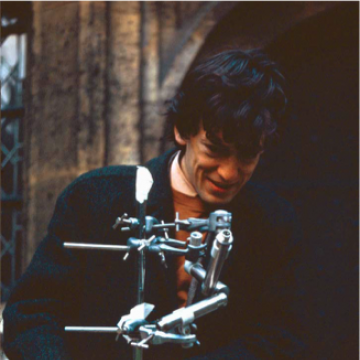
If Ambisonics has a father, it is Michael Gerzon. A mathematical prodigy at Oxford with a passion for recording, Gerzon wasn’t satisfied with the “phantom center” of stereo. He realized that sound is not a series of points on a flat plane, but a continuous vector field.
Working alongside Peter Fellgett and John Wright, Gerzon developed the mathematical framework based on Spherical Harmonics. Their goal was ambitious: to develop a system that could capture a sound field from a single point and reproduce it through any number of speakers, in any configuration.
The Failure of Quadraphonics
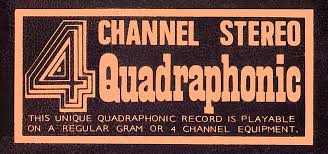
At the time, the industry was pushing “Quadraphonics” (4.0). It was a marketing disaster. There were too many competing standards (SQ, QS, CD-4), and it only provided a 2D “square” of sound. Gerzon’s team saw this and pivoted. They didn’t want a “bigger stereo”; they wanted a complete sphere.
2. The Birth of the B-Format and the Soundfield Microphone
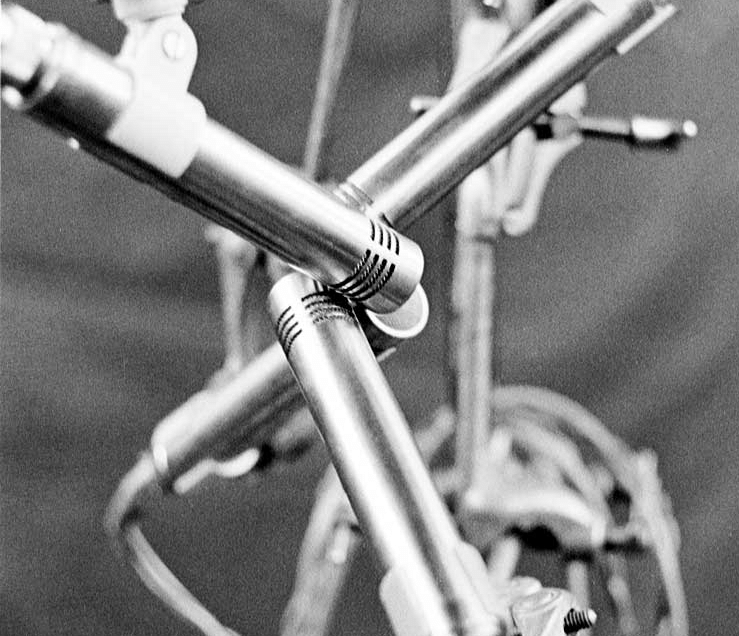
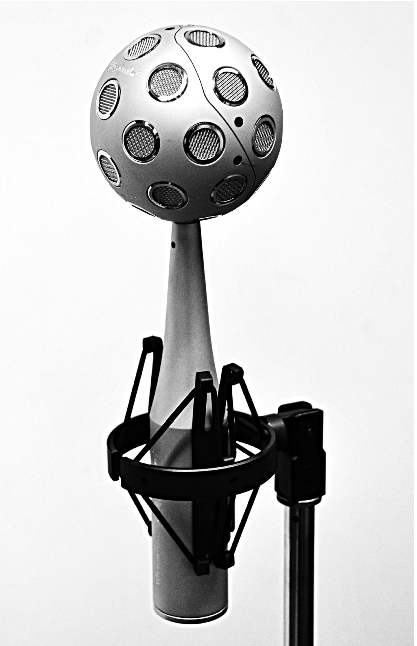
In 1978, the theory became hardware. The Calrec Soundfield Microphone was born. It was a revolutionary device containing four sub-cardioid capsules arranged in a tetrahedron.
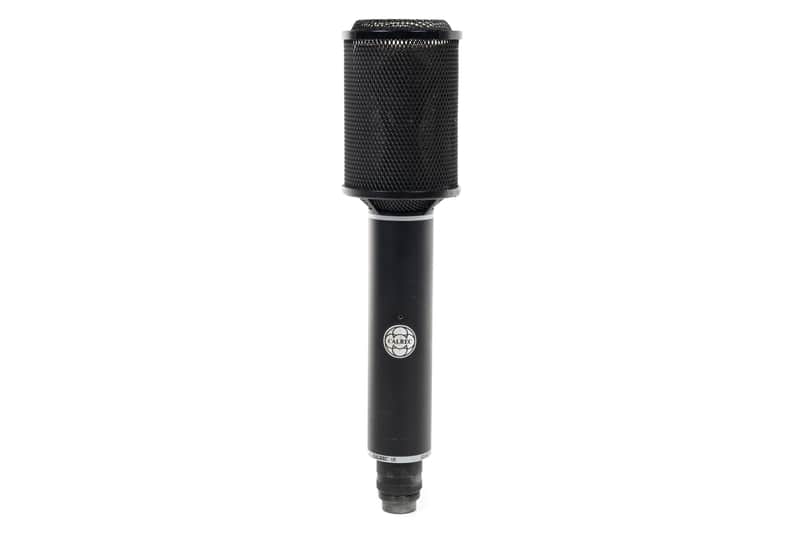
From A-Format to B-Format
This is where the magic of Ambisonics lies.
- A-Format: The raw signals from the four capsules.
- B-Format: The mathematical transformation of those signals into four specific channels:
- W (Omni): The total pressure at that point in space.
- X (Front/Back): A figure-8 pattern facing forward.
- Y (Left/Right): A figure-8 pattern facing the side.
- Z (Up/Down): A figure-8 pattern facing vertical.
This “WXYZ” set represented a First Order Ambisonics (FOA) signal. For the first time in history, a recording was “speaker independent.” You could record a concert and decide later if you wanted to listen to it in Stereo, 5.1, or through 20 speakers.
3. The “Ambisonic Winter”: A Format Without a Home
Despite its technical superiority, Ambisonics entered a “dark age” from the mid-80s to the early 2000s. Why did it fail to go mainstream?
- The Complexity Gap: To listen to Ambisonics at home, you needed a dedicated (and expensive) hardware decoder. Most consumers barely understood how to hook up two speakers, let alone four or eight in a specific geometric array.
- The Surround Sound Wars: Dolby and DTS won the 90s. They focused on “channel-based” audio (5.1). It was easier for Hollywood to mix: “Put the explosion in the rear-left speaker.” Ambisonics, being “object-based” and “scene-based,” was too abstract for the era’s mixing consoles.
- The Loss of Michael Gerzon: Gerzon passed away in 1996 at the age of 50. The format lost its most passionate advocate and brilliant theorist just as the digital revolution was beginning.
4. The Digital Renaissance: VR and the 360° Revolution
The “ghost” finally found its machine around 2014. With the advent of the Oculus Rift and the explosion of YouTube 360 and Facebook 360, a massive problem emerged: Head Tracking.
In a VR headset, if you turn your head to the left, the audio must “rotate” to the right to stay anchored in the world.
- Stereo can’t do this.
- 5.1 can’t do this without massive processing lag.
- Ambisonics was born for this.
Because Ambisonics represents the entire sound field, rotating the “sphere” of sound to match a user’s head movement is a simple, low-CPU mathematical rotation. Suddenly, the 40-year-old math of Michael Gerzon became the most important technology in Silicon Valley.
5. Modern Standards: HOA and AmbiX
As technology progressed, First Order Ambisonics (4 channels) wasn’t enough. It lacked “spatial resolution”—everything felt a bit blurry.
Higher Order Ambisonics (HOA)
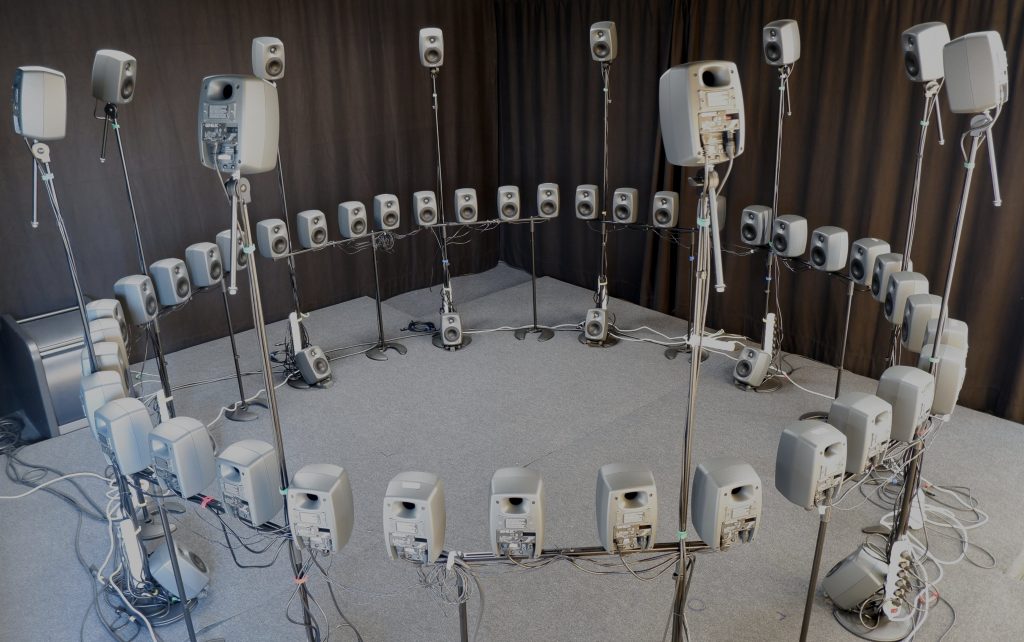
Engineers began using 2nd, 3rd, and even 7th-order Ambisonics. Instead of 4 channels, a 3rd-order signal uses 16 channels. This provides a pinpoint accuracy that allows sound designers to place sounds in a 3D space with surgical precision.

The AmbiX Format
For years, Ambisonics was plagued by two competing channel orders: Furse-Malham (FuMa) and AmbiX. Today, AmbiX (SN3D normalization) has become the industry standard, used by Google, Meta, and most modern spatial audio plugins (like DearVR or Audioease).
6. Conclusion: The Future is Spherical
Ambisonics is no longer a laboratory experiment. It is the language of immersive storytelling. Whether it’s a field recording of a rainforest in the Amazon or a complex sci-fi soundscape for a AAA game, Ambisonics allows us to capture the “soul” of a space.
At Sonik Sound Library, we embrace this history. Our Immersive and Spatial series are built on the shoulders of Gerzon’s giants, recorded with state-of-the-art ambisonic arrays to ensure that your narrative space is never just heard—it is felt.
Key Takeaways for Sound Designers:
Flexibility: It is the only format that allows for seamless 360° head-tracking in interactive media.
Ambisonics is Scene-Based: It captures the environment, not just individual sources.
Future-Proof: A 3rd-order recording can be decoded to any future speaker layout (including Dolby Atmos).