

Introduction: Beyond Point-Source Audio
To understand Ambisonics, one must first dismantle the traditional concept of “channels.” In a standard Stereo or 5.1 setup, we work with Channel-Based Audio. If you want a sound to come from the left, you send a signal to the left speaker.
Ambisonics is fundamentally different. It is a Scene-Based Audio format. It doesn’t care about where your speakers are located during the recording phase. Instead, it captures a complete 360-degree “sphere” of sound centered on a single point in space. This is made possible through a mathematical framework known as Spherical Harmonics.
1. The Foundation: Spherical Harmonics
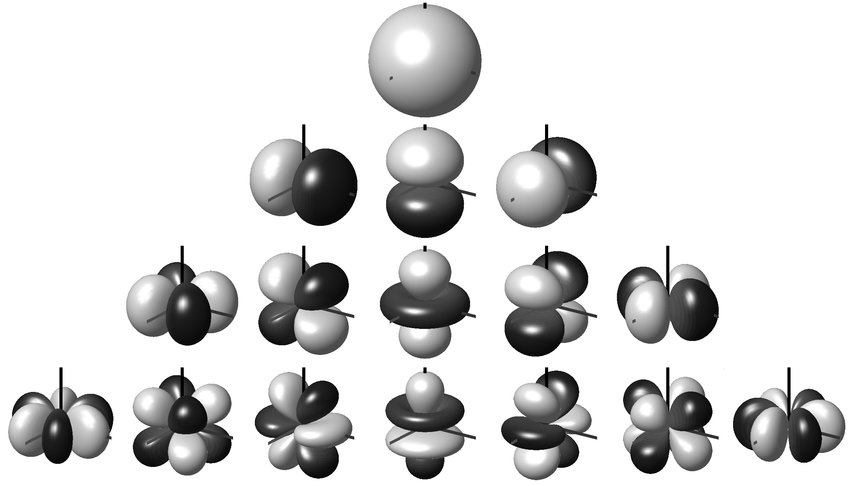
The core theory of Ambisonics relies on the idea that any sound field at a specific point in space can be decomposed into a series of functions called Spherical Harmonics.
Think of Spherical Harmonics as the 3D equivalent of the Fourier Transform. Just as a complex waveform can be broken down into a sum of simple sine waves, a complex three-dimensional sound field can be broken down into a sum of spherical components.
- Zero-Order: Represents the overall pressure (Omnidirectional).
- First-Order: Represents the pressure gradients along the three primary axes (Dipoles).
- Higher-Orders: Represent increasingly complex and detailed directional patterns.
2. The Transmission Tiers: From A-Format to B-Format
The journey of an Ambisonic signal from the microphone to your ears involves two critical stages of representation.
A-Format: The Raw Capture
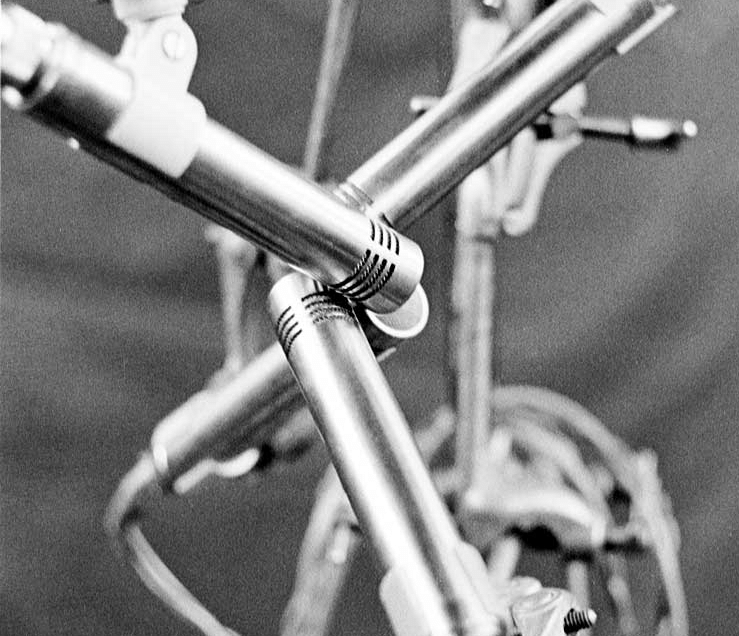
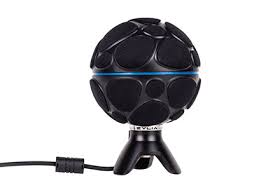
When you use a microphone like a Sennheiser AMBEO or a Soundfield mic, you are dealing with four discrete cardioid or sub-cardioid capsules arranged in a tetrahedron. The signals from these four capsules are known as A-Format. While they contain all the necessary spatial information, they are not yet “Ambisonic.” They are simply four directional recordings that share a common center.
B-Format: The Universal Language
To become a true Ambisonic signal, the A-Format must undergo a mathematical transformation (matrixing) to become B-Format. This is the standard format for processing and storage. In First-Order Ambisonics (FOA), the B-Format consists of four signals:
- W (The Scalar): The omnidirectional component. It contains the total sound pressure. It is the “body” of the recording.
- X (Front-to-Back): A figure-8 pattern capturing the longitudinal velocity.
- Y (Left-to-Right): A figure-8 pattern capturing the lateral velocity.
- Z (Up-to-Down): A figure-8 pattern capturing the vertical velocity.
These four components (W,X,Y,Z) allow us to reconstruct the sound field from any direction.

3. Resolution and Precision: Higher-Order Ambisonics (HOA)
One common criticism of First-Order Ambisonics (4 channels) is that the “spatial resolution” is low. The “sweet spot” is small, and sounds can feel “blurry” or lack pinpoint localization.
The solution is Higher-Order Ambisonics (HOA). By adding more channels based on higher-order spherical harmonics, we increase the spatial resolution significantly.
- 1st Order: 4 channels (Low resolution).
- 2nd Order: 9 channels.
- 3rd Order: 16 channels (High resolution, the current pro standard for high-end VR).
- 7th Order: 64 channels (Used in high-density loudspeaker arrays and advanced research).
The higher the order, the narrower the “virtual microphones” become, allowing for much sharper localization of sound sources within the sphere.
4. The Standardization Wars: AmbiX vs. FuMa
As the theory moved into the digital realm, a conflict arose regarding how to order the channels and how to normalize the levels.
FuMa (Furse-Malham)
The traditional standard used in the early days. It uses a specific channel order (W,X,Y,Z,…) and a normalization known as MaxN. While it was the pillar for decades, it is now considered “Legacy.”
AmbiX (Ambisonic Exchange)
The modern winner. AmbiX uses the ACN (Ambisonic Channel Numbering) and SN3D normalization. This is the format required by YouTube, Meta (Facebook), and most modern VR engines.
- Why it won: It is more scalable for Higher-Order Ambisonics and handles signal levels more efficiently for digital distribution.
5. Decoding: The Speaker-Independent Magic
The most powerful theoretical advantage of Ambisonics is that it is Speaker-Independent.
In channel-based audio, if you mix for 5.1, your mix only works perfectly on a 5.1 system. In Ambisonics, you mix once in the “B-Format sphere.” This master mix can then be decoded to any playback system:
- Binaural: For headphones (using HRTFs – Head Related Transfer Functions).
- Stereo: A simple downmix.
- 5.1, 7.1, or 9.1.4 (Atmos): Mapping the sphere to specific speaker coordinates.
- 22.2 Arrays: For specialized immersive theaters.
The decoder acts as a “virtual microphone” array, extracting the signals for each speaker based on its position relative to the center of the Ambisonic sphere.
6. Conclusion: Why Theory Matters for the Sound Designer
Understanding the theory behind Ambisonics isn’t just an academic exercise. It changes how you record and how you mix.
When you record a Room Tone or an Urban Interior in Ambisonics, you aren’t just capturing a “stereo file.” You are capturing a mathematical snapshot of a physical space. This snapshot allows the end-user (the film editor or game developer) to rotate, tilt, and manipulate that space to fit their narrative perfectly.
Ambisonics is the bridge between the physics of sound waves and the infinite possibilities of digital 3D space.
Products by Category
-
Complete Bundle
Original price was: 985.00 €.499.00 €Current price is: 499.00 €. Excl. Vat -
Immersive Bundle
Original price was: 484.00 €.299.00 €Current price is: 299.00 €. Excl. Vat -
Spatial Bundle
Original price was: 343.00 €.199.00 €Current price is: 199.00 €. Excl. Vat -
Standard Bundle
Original price was: 158.00 €.99.00 €Current price is: 99.00 €. Excl. Vat