

Most people usually think sound design is exclusively about the “big moments”: bone-crunching impacts, thunderous explosions, high-speed car chases, or those haunting, dark atmospheric structures that define horror films. However, nothing could be further from the truth. While those elements provide the spectacle, the true mastery of sound design lies in its subtlety. It is the art of making the audience feel the movie without ever consciously perceiving the work behind it.
As sound designers and editors, we face a daily challenge: constructing a sense of absolute realism. We don’t just “play” sounds; we build complex, multi-dimensional sonic environments in post-production. While location sound provides the foundation, it is rarely enough to sustain the immersive weight of a modern cinematic experience.
The Paradox of the Film Set
Location sound mixers and their teams are the unsung heroes of production. Their primary mission is to capture “clean” dialogue—voices free from distracting noises. To achieve this, they meticulously acoustically treat and soundproof the film set, often using highly directional microphones to isolate the actors.
While this is essential for clarity, it creates a technical paradox: the resulting audio is so “clean” that it feels detached from reality. It sounds like a voice in a vacuum, completely isolated from the physical space it is supposed to inhabit. This is where the post-production magic begins. Our job is to “re-spatialise” these voices, bringing back the “lost spaces” through the surgical use of room tones and ambient textures.
Room Tones: More Than Just “Silence”
Room tones are often mistaken for silence, but in the world of audio, silence doesn’t exist. Every room has a “voice”—a unique combination of air pressure, distant hums, and acoustic reflections. In post-production, room tones work as a glue, adding subtle movement and life to the dry dialogue captured on set. They enhance the spatial feel and the acoustic perception of the scene, telling the listener’s brain exactly how large the room is and what the walls are made of.
If you perform an A/B comparison of a scene with and without a dedicated room tone layer, the difference is jarring. Without it, the dialogue feels like a recording; with it, the voice suddenly breathes, feeling integrated into a real, living, and vibrating space.
The Underpainting of the Sonic Canvas
I often use a metaphor from the world of fine arts: I like to think of room tones as the underpainting upon which all other sound objects are detailed. In classical painting, the artist never starts on a stark white canvas. They apply an initial layer of color—the underpainting—to establish depth, mood, and “materialism” before the first detailed stroke is even made.
In our craft, room tones are that foundational layer. They cover the digital “blank canvas” of the timeline, providing a rich, textured base. Without this “underpainting,” the final painting lacks depth; the footsteps, the foley, and the music would simply “sit on top” of the image rather than belonging to it.
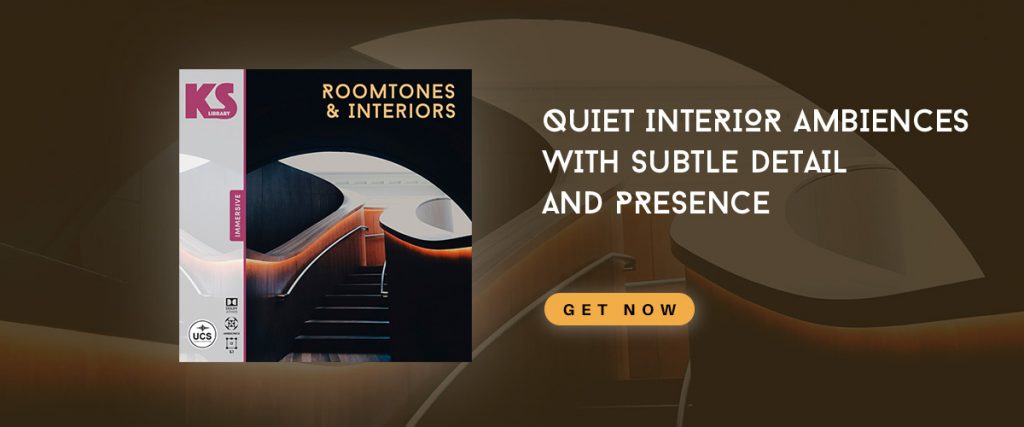
Introducing the “Roomtones & Interiors” Collection
At Sonik, we understand that finding the right “base layer” is often the most time-consuming part of the edit. That is why we have developed Roomtones & Interiors, a brand-new immersive sound collection specifically designed to meet this essential need for sound designers and editors.
This isn’t just a library; it is a professional toolkit crafted to provide that essential “quiet” that breathes life into a scene. Whether you need a grounding bed for dialogue or a complex Atmos environment, these sounds offer the perfect balance between presence and invisibility.
Authentic Textures for Every Narrative
Our collection offers a wide array of carefully captured indoor ambiences, each possessing its own unique acoustic character and environmental nuance:
- Lived-in Spaces: Bring domestic realism to your scenes with the mechanical hum of kitchens, the clank of boilers in laundries, or the rhythmic ticking of clocks in dining rooms.
- Environmental Nuance: Add layers of depth with subtle neighbor movements, distant rain against glass, or the haunting sound of exterior voices filtering through open windows.
- Abandoned & Unique Textures: Explore the eerie, still acoustics of windowless rooms and empty rural buildings—perfect for building tension and suspense.
- Dynamic Organic Layers: Enhance your settings with localized details like gas hisses, small dogs, or the distant call of tropical birds.
Technical Excellence & Immersive Workflow
We believe that high-quality sound should be matched by high-quality metadata. Roomtones & Interiors has been captured with professional-grade gear, including the Rode NT-SF1 ambisonic microphone and Zoom F8 recorders, ensuring a pristine signal-to-noise ratio.
To ensure a seamless workflow, the library is UCS (Universal Category System) Compliant and comes fully embedded with rich metadata for BaseHead, allowing you to find the perfect sound in seconds.
Format & Specs:
- Size: 11.46 GB of high-end, immersive content.
- Library Structure: 60 files featuring 15 unique, versatile locations.
- Ready for Any Mix: Delivered in AmbiX format, with decoded versions in Stereo, 5.1, and 7.1.2 beds, making it 100% ready for Dolby Atmos projects.